
This Is Not a Special Label! A Human Rights Convention Exploring Diverse Circumstances—the CRPD, Giving Everyone the Right to Decide the Life They Want
CRPD’s technology applications and impact

The advancement of technology has brought a lot of convenience to our lives—in learning, entertainment, family life, and more, technology makes many processes easier. But what about for people with disabilities? Currently, there are many assistive technology applications—for example, curriculum guidelines mention that teachers must provide assistive technology—and it all starts with the CRPD.
What is “CRPD”?
Simply put, it originates from the United Nations’ 2006 Convention on the Rights of Persons with Disabilities (hereafter “the Convention”), which advocates for protecting the rights of people with disabilities, ensuring their equal opportunity to participate in society, politics, economy, and culture, and promoting their independence and development. Taiwan passed related domestic regulations in 2014. While it has no absolute enforceability, it has changed many policies and public facility regulations, and precisely because it’s not law, the CRPD is regarded as a spirit, culture, and advocacy.
There are eight important principles of the CRPD:
(a) Respect for inherent dignity, individual autonomy including the freedom to make one’s own choices, and independence of persons
(b) Non-discrimination
(c) Full and effective participation and inclusion in society
(d) Respect for difference and acceptance of persons with disabilities as part of human diversity and humanity
(e) Equality of opportunity
(f) Accessibility
(g) Equality between men and women
(h) Respect for the evolving capacities of children with disabilities and respect for their right to preserve their identities
But what’s the connection with assistive technology?
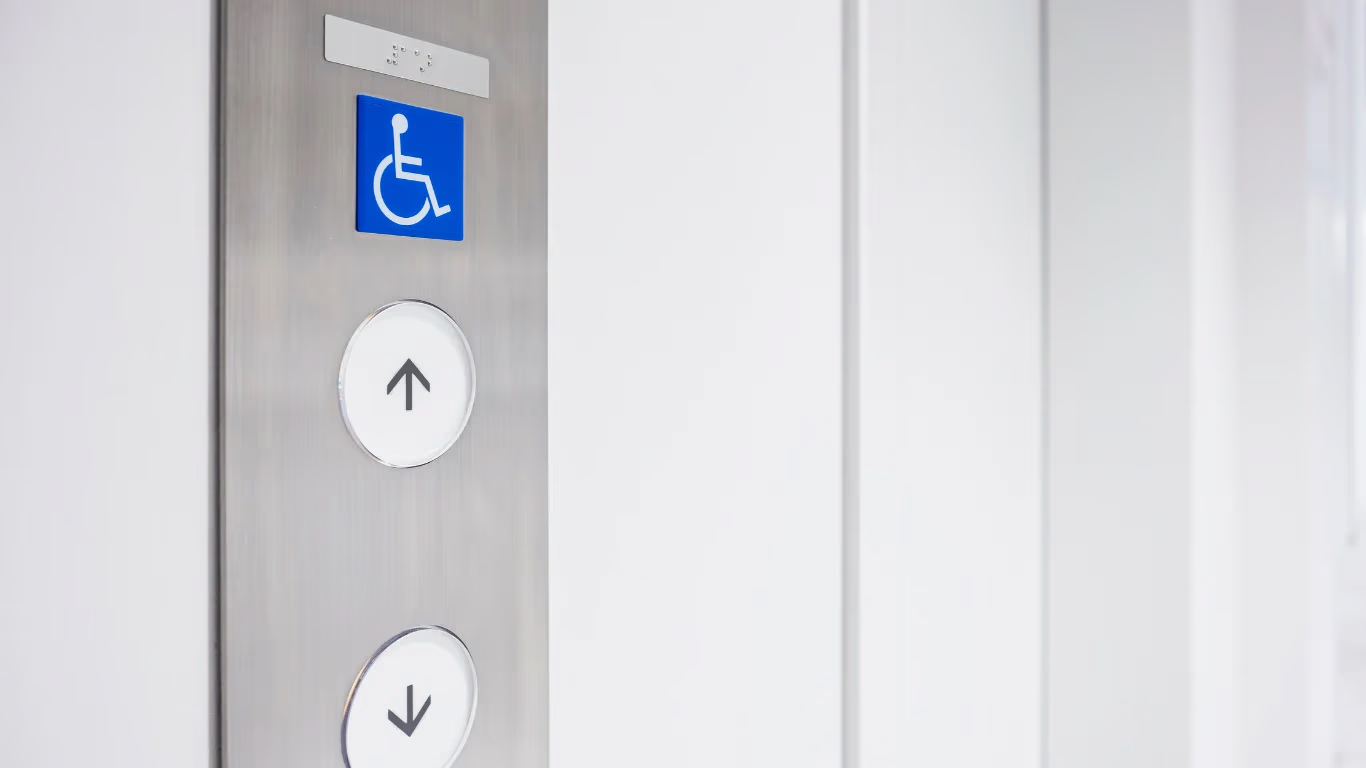
From our team’s conversations with people with disabilities, we found that for them, specifically designating a particular facility as “barrier-free” is not a form of respect—rather, it feels like a form of discrimination. They mentioned that true accessibility, in their view, means treating them like everyone else and implementing accessible facilities everywhere, so that everyone can conveniently use public facilities—that’s what a comfortable and respectful environment looks like for everyone. This is also what the CRPD emphasizes as “inclusion and mutual benefit.” Therefore, incorporating environmentally applied assistive technology, so that every citizen can enjoy a convenient, accessible life, is what truly realizes the foundational infrastructure of an entire city or country. As mentioned in our previous article [“Is Infrastructure Ready to Support the Needs Brought by Taiwan’s Aging Wave?”], if the infrastructure cannot truly become barrier-free, how can we even talk about “inclusion and mutual benefit”? And achieving such results doesn’t rely on government alone—citizens and businesses must join together to reach the goals within the CRPD.
To learn more about the current state of CRPD implementation in Taiwan, please refer to:
Ministry of Health and Welfare, Social and Family Affairs Administration – CRPD (Read More)
Covenants Watch – CRPD | Convention on the Rights of Persons with Disabilities (Read More)
The News Lens Plurality – What Is CRPD? A Quick Guide to the Basic Concepts (Read More)
Owlsome Tech – Is Infrastructure Ready to Support the Needs Brought by Taiwan’s Aging Wave? (Read More)
Liu, Chia-Cheng (2018). A Brief Discussion on the Possible Impact of the CRPD on Taiwanese Society. Department of Human Development and Family Studies, National Taiwan Normal University.
Ministry of Education (2019). Application of Assistive Technology in the 12-Year Basic Education Curriculum Guidelines for Special Educational Needs.