
Job Vacancies Hit a Record High! The Industrial Future Driven by Taiwan’s Labor Shortage Crisis

According to population statistics from the Directorate-General of Budget, Accounting and Statistics, as of 2022 the population aged 15-44 was only 9,264,291—a decrease of 12.29% in the labor population over the past decade.

Demographic shifts have made labor shortages the new normal
This shows that the labor shortage problem of recent years is not a worsening unemployment issue, but rather that the actual working-age population has shrunk by about 13% compared to a decade ago. In addition, young people today have more diverse career options—manufacturing job vacancies continue to rise due to Taiwanese businesses returning from overseas, some choose to work for foreign companies operating across borders, and even more people choose to become solopreneurs or start their own businesses. According to the 2021 annual employee salary statistics released by the Directorate-General, although nominal wages increased slightly, when accounting for inflation, this marks the third real wage decline in the past decade.
According to the Willis Towers Watson salary survey, Taiwan’s wages rank relatively behind compared to other Asian countries, even lower than Japan, Korea, Singapore, and Hong Kong. Behind this lies not only the issue of a declining birth rate, but low wages are also a root cause discouraging young people from marrying and having children—further worsening the declining birth rate and labor shortage.
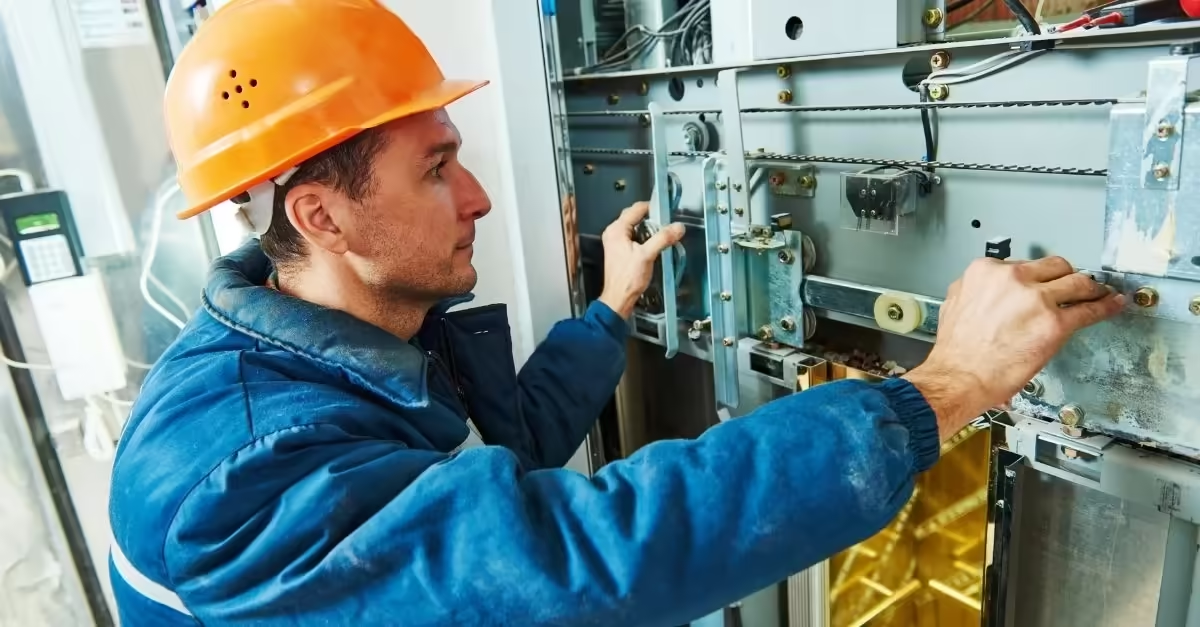
As Taiwan’s social structure changes and the population ages, the number of elevators keeps increasing, correspondingly raising the demand for maintenance technicians. However, relative to demand, the current supply of maintenance technicians is clearly insufficient.
Labor shortages in high-risk professions become an opportunity for transformation
The causes of the labor shortage, besides a lack of sufficient training opportunities and professional talent development, include the fact that elevator maintenance requires related skills and knowledge in mechanics, electronics, and electrical engineering. Additionally, the specialized and high-risk nature of the work also contributes to unstable talent supply.
 Shortage of Class A and Class B elevator maintenance technicians
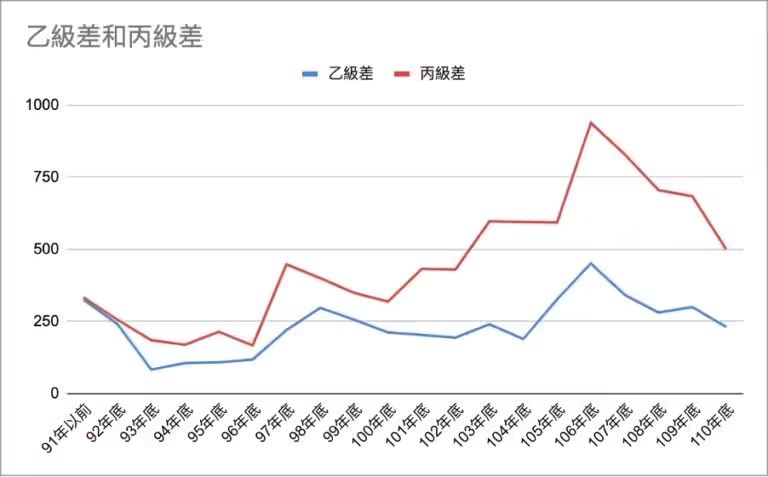
Especially in the elevator industry, which is a relatively labor-intensive service model—based on central statistics, there are only about 9,000 to 10,000 licensed elevator maintenance technicians, with each technician responsible for an average of about 134 elevators, already exceeding the regulatory standard of 50 elevators per technician.
Taiwan will face a labor shortage crisis in the future, and the elevator industry, being a high-risk, labor-intensive industry, will struggle to attract talent, raising concerns about the future quality of elevator maintenance.
Change is unstoppable, and industrial transformation is imminent—traditional industries facing smart transformation will be the trend of future change. In recent years, many elevator brands have introduced smart elevator systems. Smart technology can provide functions such as automatic monitoring, predictive maintenance, and remote monitoring, thereby reducing the need for human resources and improving operational efficiency and performance. For example, currently, elevator malfunctions are mostly discovered only when customers complain or personnel report them—property managers passively contact vendors for repair afterward. Only once a maintenance technician arrives on-site can they begin troubleshooting. This process not only takes up considerable communication time but may also fail to effectively identify the real issue that needs solving, making AI data support especially important.
By installing sensors on elevators, collecting real-time data, and connecting to the cloud, AI can help us effectively manage elevator dynamics—not only improving efficiency in troubleshooting, but also creating opportunities for preventive handling through data:
Through remote monitoring systems, maintenance personnel can monitor elevator operation status in real time, promptly detecting faults and predicting potential issues, reducing the need for on-site inspections and saving human resources.
Smart systems can automatically identify elevator faults, saving the time needed for manual inspection and repair reporting, improving maintenance efficiency.
Smart systems can provide valuable information about elevator operation status, usage patterns, and passenger flow through data analysis. This helps management make more scientific decisions, optimizing operational processes and resource allocation.
High costs of elevator transformation make market adoption difficult
However, elevator replacement and transformation cannot be achieved in just a year or two. High development and replacement costs, combined with an unclear market, mean many owners remain cautious. Building owners tend to keep their existing elevators until their service life expires, or replace parts rather than the entire unit. High costs and a relatively closed industry are the main reasons elevator transformation has lagged behind.

Facing this dilemma, Owlsome Tech’s LiftMind elevator intelligence system is specifically designed to be installed as a plug-in add-on to existing elevators—like a smart TV box concept. By adding sensors and other devices, it collects big data on elevator operation, and after edge computing, owners can easily monitor elevator activity through a cloud management platform, while also gaining access to many IoT functions.
Efficient operation: achieves the fastest crowd dispersal, reducing elevator wait times while saving energy
Smart safety: proactive detection such as entrapment and earthquake information can quickly relay messages to personnel and evacuation
Smart friendliness: can directly designate a target floor’s destination object, enabling voice control of the elevator with corresponding visual prompts
Value creation: presents data analysis results on a back-end system, allowing owners and maintenance vendors to understand elevator operation status, and can be paired with advertising content for external distribution
Change can no longer be stopped, and Owlsome Tech will serve as an industry partner, accompanying everyone through the growing pains of transformation.
2022/02/21 The News Lens - Wages still can’t keep up with inflation, real wages decline for the third time in nearly a decade
2023/05/24 The News Lens - Taiwan’s labor shortage isn’t due to declining birth rates but low wages—only three paths to solving it
2023/06/05 1111 Job Bank Forum - HR Insights: 4 Key Issues Behind Taiwan’s Labor Shortage: Young people aren’t refusing to work, they just won’t work for you