

Decoding the Digital Transformation of Healthcare – Smart Healthcare

The aging population keeps rising while caregiving manpower falls severely short
With the help of technology, medicine has advanced rapidly since the 19th century, extending average human lifespan from 40 to 80 years. However, this has also placed enormous strain on healthcare systems.
According to McKinsey & Company, by 2050 a quarter of the population in the US and Europe will be over 65. As the population ages, hospitalization rates will rise, yet the world is facing a severe shortage of healthcare workers.
Taiwan’s population is aging even faster—the National Development Council estimates that by 2032, more than a quarter of the population will be over 65. As the number of patients surges, the shortage of medical staff persists. If current high healthcare standards continue without structural change, the healthcare system risks collapse.

AI steps in: smart healthcare enters a transformation period
“Managing so many patients is costly—the healthcare system must shift from episodic treatment to preventive and long-term care management.” This is the direction of smart healthcare transformation.
Smart healthcare has therefore gained increasing attention. Applications such as AI and automation aim to improve the efficiency of healthcare. As major tech companies enter the field, Taiwan’s direction for developing smart healthcare has become clearer.
Smart healthcare is an innovative model that integrates advanced technology with medical services, aiming to improve the efficiency, quality, and accessibility of the healthcare system. It combines IoT, AI, big data analytics, and remote monitoring to improve medical processes and decision-making through data collection, analysis, and application—delivering more precise, personalized, and reliable medical services.
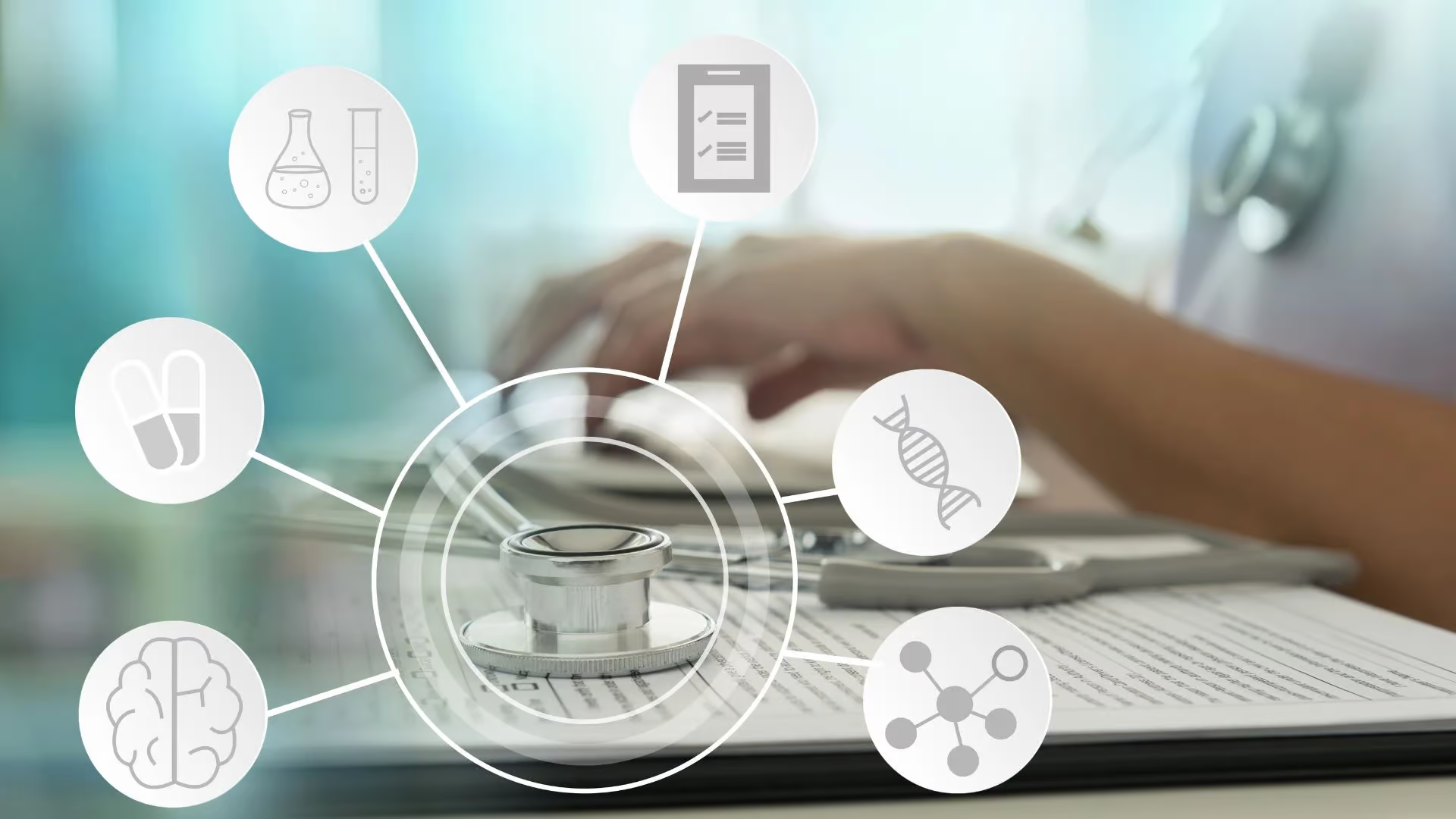
Six key technologies of smart healthcare:
AI, Blockchain, Cloud, Data, Edge Computing, and Fifth Generation (5G)
For smart healthcare to succeed, a full ecosystem is required—sufficient data sharing and interoperability requires the government, healthcare institutions, tech companies, academia, and patients to share resources and knowledge, driving application and innovation. At the same time, an appropriate legal framework and privacy protection are essential.

To more concretely promote digital health technology, the US FDA announced the establishment of the Digital Health Center of Excellence in September 2020, signaling the importance the US places on digital health development. The center oversees mobile health devices, Software as a Medical Device (SaMD), wearable medical devices, and digital technologies for medical product research.
Taiwan has also proposed the “Precision Health Strategic Industry Development Program,” jointly led by the Ministry of Science and Technology, the Ministry of Health and Welfare, and the Ministry of Economic Affairs, with an estimated NT$9.5 billion investment over four years to build a comprehensive precision health ecosystem, introducing AI, IoT, 5G, and wearable devices—“expanding precision medicine into precision health.”
Smart medical devices are making AI healthcare ubiquitous
Using AI to replace or assist large volumes of repetitive administrative work or diagnostics, such as medical imaging interpretation, is the current stage of smart healthcare development. Remote monitoring, AI alert systems, and virtual assistants—whether in the hospital or at home—allow patients to take greater responsibility for their own health. As this stage progresses, departments with faster AI progress, such as oncology, cardiology, and neurology, will require closer professional collaboration to tightly integrate smart healthcare solutions with clinical workflows.
At the same time, smart elevators are becoming an indispensable part of the digital transformation of the healthcare system. Through intelligent operation and innovative features, these elevators not only effectively improve patient safety but also improve the overall operational efficiency of the healthcare system. Let’s explore how smart elevators play an important role in healthcare environments, bringing a better experience to patients.
Solving bed-elevator congestion and surgery delays
First, a hospital’s bed-transport load is one of the key factors in choosing a smart elevator. If a hospital needs to transport a large number of patients or beds daily, a smart elevator becomes an essential tool for managing these processes.
From our past client cases, most hospitals distinguish between passenger elevators and bed elevators, but in practice, to prevent bed elevators from being occupied, a dedicated elevator mode must be activated to reduce the risk of bed-elevator congestion that could delay critical surgeries. However, hospitals typically assign nurses to stand by the elevator all day to manage it—a waste of medical staff. With LiftMind’s cloud management system, we use intelligent remote control to solve the problem of medical staff spending an entire day managing elevators, while also effectively tracking elevator movement during emergencies to seize rescue opportunities.
Smart elevators provide real-time information on ride status, direction, and capacity, enabling medical staff to arrange patient transport more efficiently, improving work efficiency and reducing patient wait times. Office staff can perform “remote elevator control” dispatch and use “remote intercom” to guide people inside the elevator to designated floors, eliminating the need for nurses to stand guard and freeing them for other duties.
Seizing the golden rescue window—smart detection of trapped patients
What if someone faints or is incapacitated inside an elevator and cannot call for help?
Since the emergency button in an elevator requires an active call for help, if someone faints inside an elevator or suddenly cannot call for help, someone must discover it before it can be resolved—yet within a short time, that person’s life could be in danger.
Therefore, a hospital’s safety and emergency rescue capability is also a key factor in choosing a smart elevator. Smart elevators are equipped with active detection functions that can instantly detect emergencies inside the elevator, such as a patient fainting or a sudden incident. When a rescue signal is triggered, management staff can immediately communicate and understand the patient’s condition, quickly contact relevant personnel for rescue, and simultaneously calm the passenger. This real-time rescue capability is especially important for hospitals that require high vigilance and rapid response.
Launching smart transformation, creating new elevator value
Elevators are no longer just tools for vertical transport—they can also be combined with new applications in energy saving and security, and elevator intelligence is no longer an unreachable goal requiring huge expense. Owlsome Tech’s innovative technology applications make smart transformation no longer complex or difficult. Through one-stop management services, let Owlsome Tech be your partner as we contribute to smart healthcare and add value to our lives.
Future City | Understanding Smart Healthcare in One Read